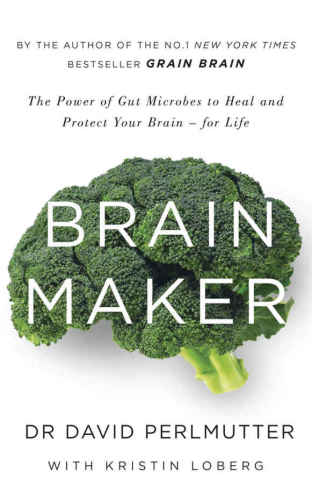
“Brain Maker: The Power of Gut Microbes to Heal and Protect Your Brain for Life” is a detailed and innovative book by neurologist David Perlmutter, which makes strong claims about the relationship between brain health and gut health, and then backs it up with evidence. Not only does the author discuss different kinds of bacteria that live in the gut, and various methods by which imbalances make diseases, but he also goes on to give diet recommendations, and cites patients of his who recovered from horrible diseases like severe autism by following the principles in his book (under doctor supervision, some may have gone as far as fecal transplants, the author does not recommend enemas or fecal transplants without the supervision of your doctor). This book has inspired me to quit the sugar substitutes, to start brewing kombucha, and to begin exploring the wide world of fermentation.
Here are 11 things I learned from this book.
- An imbalanced microbiome can affect everything from heart disease, obesity, and sleep to autoimmune diseases, Multiple Sclerosis, dementia, autism and more.
The book talks about different ways each manifest, where obvious causes are visible. For instance he cited a study showing mice that developed autistic symptoms after being given more of a particular compound. As it turns out, the same drug is produced by certain strains of gut flora, particularly in people who do not have gut healty habits, and elevated levels of this drug can be seen in the blood stream of autistic children. The author goes on to talk about how he helped a child with autistic symptoms by prescribing probiotics. (Sorry i keep calling it “this drug”, i forgot the name).
- Inflammation is the primary path by which the above paths occur.
While some pathologies like autism mentioned above appear to have a specific link within the gut, most of the time it has to do with the fact that the gut is the seat of the body’s immune system.
- Lactobacilis is a good bacteria.
Lactobacilis comes from the word “lactose”, and references the bacteria who break down the sugar in milk. One can get more lactobacilis by eating yogurt. However for those of us who cannot have milk products (I myself am allergic), lactobacilis bacteria is favoured whenever vegetables are fermented in brine. Since that just means sticking veggies into a jar with some salt, it is well worth the money to attempt.
- Vaginal birth, followed by breast feeding is a baby’s first innoculation.
As it turns out the act of passing the baby through the vagina exposes the child to a wealth of bacteria that will be the foundation of the infant’s gut microbiome. Often also women will push so hard that involuntarily poo will come out as well. When the baby brushes up against that also appears to be part of the ritual, and babies born vaginally tend to have a microbiome high in the lactobacilis gut flora. By contrast, babies born through C-section tend to have a microbiome consisting of the bacteria that grows on the skin, which puts the baby off to a bad start. If you have to do a C-section, there are measures you can take to correct this.
- Kombucha is very good for the microbiome, as are wine, coffee and tea.
For those who don’t know, kombucha is a drink consisting of fermented sweet tea. There is a special culture that does the fermentation that is this brownish blob of symbiotic bacteria and yeast called a SCOBY. Having tried it, it’s quite good. I highly recommend it as an alternative to soda. While wine has the added benefit of being fermented, it shares with coffee and tea in common that they have plenty of polyphenols. Polyphenols are colour-giving compounds, they are responsible for the orange of carrots, the redness of wine, the blackness of coffee, and the brown-ness or green-ness of tea. Recent nutritional research has been uncovering enormous benefits from the consumption of polyphenols, and is one of the reasons nutritionists advocate you get your vitamins by eating whole vegetables instead of taking a suppliment. For the above reason, i’ve attempted to make kombucha, which is hopefully brewing now. First pic is at the bottom of this post.
- Processed sugar as well as sugar substitutes can affect the microbiome in undesireable ways.
Different bacteria are more or less good at processing the foods you give them. Some bacteria are better at digesting sugar, so when you eat sugar you encourage their growth. There is even some research showing that those bacteria, despite being trapped inside the intestines, are capable of emitting compounds that cross the intestinal barrier, go all the way up to the brain, and cause sugar cravings. For that reason you might think avoiding sugar is enough, and so in my coffee i would put artificial sweeteners like splenda. As it turns out, while we cannot ourselves digest splenda, gut bacteria can, and you may not like them.
- Gut flora influence hormone levels, including hormones for sleep and hormones for extraversion.
Much of this can be inferred from the above story about sugar cravings. Evidently this has been studied as well. One general rule of diet that i’m attempting to adopt, is to watch how i feel after eating. You know how you get up from some meals and you feel strong and energized, and after some meals you tired or sick? I’m gonna try to take note of what I feel and eat more of the former. So far i’ve discovered that lots of cake is bad.
- Virtually everyone is more or less gleutin intolerant. The author suspects this may have to do with Monsanto’s Roundup, which gets sprayed on nearly all genetically modified crops.
Some of this has to do with the presence of a leaky gut. Many people who ingest gleutin also somehow ingest compounds that damage the interior lining of the intestines, allowing larger undigested molecumles to pass through. It’s speculated that this could be the source of much of the non-celiac gleutin hypersensitivities, as a leaky gut will certianly inflame the immune system. The immune system will then repond by acting is if it’s being infected and look for a culprit, and upon seeing large partially digested chunks of gleutin that definitely shouldn’t be in the blood stream, develops a hypersensitivity to them. (For those who don’t know, a hypersensitivity means that the adaptive immune system, the thing that makes us immune to previous infections, accidentally mistakes something benign as a pathogen, and proomtes an immune reaction that causes the body all sorts of trouble when you’re exposed to that benign compound agian. An allergy is one subtype of hypersensitivity.) The author suspects this may have to do with Monsanto’s Roundup, which gets sprayed on nearly all genetically modified crops. He offers some connection between roundup and the leaky gut but i’ve forgotten what it is. His claim is worth investigating as it relates to the question of whether to eat GMOs.
- Fiber = prebiotics.
Throughout the book the author repeatedly uses the word prebiotics without taking much time to define it. He appears to be referring to the types of foods that gut flora eat, that are most liked by the gut flora that you want. Apparently, good gut bacteria like to eat fiber, and when we eat fiber, we’re feeding them.
- Enemas can be a powerful way to treat microbiome problems.
The author did not spend a lot of time explaining why enemas were good compared to taking a pill. If you talk to your doctor about autoimmune disorders or neurological problems, and you also happen to have irritable bowels or digestive issues, an enema may be able to help you with both problems. While you’re there you can ask about the specific advantages of sticking it up the pooper.
- Gut bacteria also like exercise.
Something something your intestines like blood flow, something something don’t let your body become a cesspool, you fat puddle! To be fair, excercise is very important for circulation, far beyond just getting the heart rate up. One is that muscular movement helps veins to work against gravity in bringing the blood back up to the heart, and to much sitting can lead to blood pooling in the form of hemmeroids or vericose veins. More, there is a current of fluid throughout the body that moves independently of the blood vessels. The fluid is called lymph, the ducts/canals it passes through are called lymph ducts, and the nodes where it gets processed are called lymph nodes. One thing that makes many cells of the immune system unique is that it can navigate and function along the lymph network, but lymph is almost entirely driven by bodily movement. Do ten squats now.
All in all, this was a very informative book. The conclusions the author made were enough to surprise me. Having read a few books on diet and nutrition, and reading some of the science news, i don’t expect to be surprised often. If my dietary changes lead to a significant improvement in my energy levels and mental clarity, i will write about it. In the meantime, here is a picture of my jars of tea, packed and beginning to ferment into kombucha.