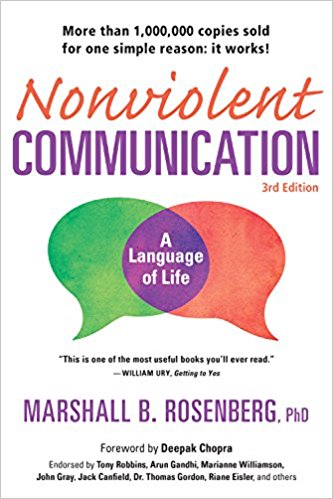
“Nonviolent Communication: A language of life” by Marshall B. Rosenberg, phD. is a special book for me, as it is the one and only book I can credit where I became permanently happier after reading it. Far more than interpersonal communication, it has changed the way I talk to myself. Here are some of the things I learned from this book.
- All insults are the expression of unmet needs. You can diffuse the situation (and feel less pain on hearing an insult) by listening for the underlying need being expressed.
- Communication is about meeting the needs of everyone involved to their satisfaction, and for enabling people to celebrate life together.
- Passing judgement shackles growth to shame and makes people resistant to suggestions/requests.
- Anger is the manifestation of other emotions, usually pain and fear.
- Practicing NVC requires us to take responsibility for our own emotions, by separating them from the stimulus. (Observe without evaluating). And then identifying the underlying unmet need,
- When you did <action>, I felt <emotion> because of <unmet need>. Would you we willing to <request for positive action to meet need>
- Gratitude and praise can be alienating when expressed in the form of a judgement. When phrased in the format “When you did <action>, I felt <good emotion> because of <need it met>, then appreciation can be a mutual celebration of life.
- When making/interpretating a request, it’s important to separate a need from the strategy used to meet that need.
- Use of the words “should” and “have to”, bind us to external morality and judgement. We take full responibility for our actions by replacing “have to” with “choose to.”
- Using NVC is a powerful tool for getting along with ourselves, by applying self-empathy to listen to the unmet needs in our own internal judgements.
- Don’t be afraid to interrupt when mediating a conflict when the purpose of said interruption is to bring people’s attention away from judgements and back towards their feelings and unmet needs.
- When mediating, aim to satify everybody’s needs, not compromise. ‘Compromise’ as a standard encourages people to leave unsatisfied.
- Reflecting back to someone is a way to show you understand their feelings and needs.
- “So when when I do <action> you’re feeling <emotion> because of <unmet need> and you would like me to <specific action>?”
- You don’t have to be right. If you get silence or judgement, substituting guesses in the above format is useful because even when you’re wrong you’re still directing the person’s attention to his/her unmet needs.
- When making a request, convert it into an action tht can be seen/heard on a camera. Nothing vague.
- “Attacked”, “betrayed”, “insulted” are judgements, not feelings. “Sad”, “annoyed”, “frustrated”, “scared”, “buoyant”, “elated”, “joyous”, “grateful” are emotions.
- The difference between a request and a demand is whether you’re punished for saying “no.”
- “No” is an expression of unmet needs. It is not necessarily a rejection.
- For ourselves: to make life like play, write out everything you do that does not bring you joy, or that you do out of a sense of obligation. Write out “I choose to do <action> because i value <need it serves>”.
- If I free myself from my own judgemental language, then i can grow, and that growth can be a celebration of life instead of something that’s tied to guilt/shame.
- When dealing with a dicy subject, ask for a reflection of what you said, as even when you make an NVC request properly, the other person can in their pain hear a judgement or demand. Slow down and check to make sure they don’t hear it as judgement or as a demand.
- Don’t just do something, stand there!
- It is possible to scream non-violently. It is an expression of pain/frustration and the unmet need it contains, without the judgement.
Dr. Rosenberg also did workshops which are a great deal of fun to watch. I highly recommend you check them out here.
Notes: NVC Model = Observations -> feelings -> needs -> requests